MCube - the "Munich Cluster for the Future of Mobility in Metropolitan Regions" - is a future cluster funded by the BMFTR (Federal Ministry of Research, Technology and Space) and has been in its second funding phase since November 2024. Under the leadership of the Technical University of Munich and together with over 80 partners from science, business, society and administration, we are shaping the mobility of tomorrow - innovative, sustainable and transferable to other regions.
Our goal is to bring mobility innovations into practice more quickly. To this end, we develop new ideas, business models, administrative principles, co-determination formats, patents and practical prototypes.
The focus is on central mobility topics such as autonomous driving, electromobility, smart infrastructures, legal framework conditions and the livable redesign of public spaces.
Facing challenges in mobility? We support your transformation
The mobility of tomorrow affects us all. Whether sustainable transport planning, innovative technologies or smart solutions for urban and rural areas - the challenges are many and varied.
Do you have questions about the mobility of the future? Or are you facing specific challenges in your municipality, your company or your research?
Our cluster brings together science, business, society and the public sector - to find answers together.
MCube develops innovative solutions for the mobility of the future. We offer a wide range of services to promote sustainable, networked and future-proof mobility concepts. You can find an overview of our services here:
We create knowledge and practical skills to support cities and municipalities in implementing responsible governance models and innovative mobility experiments.
We are creating a digital basis for comprehensively mapping mobility in the metropolitan region and testing the effectiveness and safety of future measures before they are introduced.
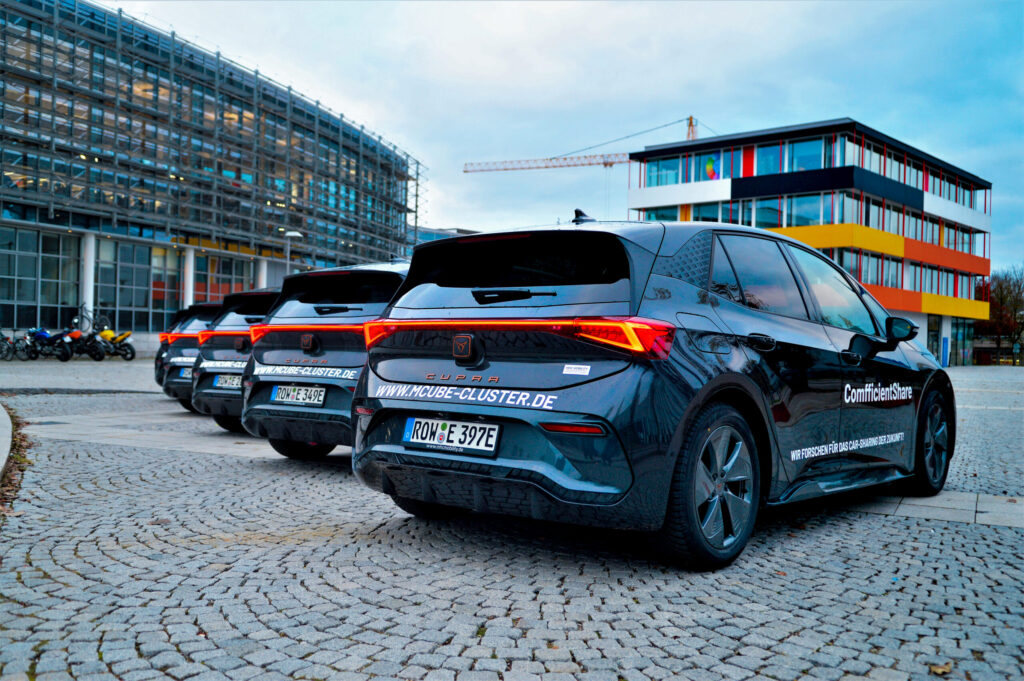
We are investigating the potential impact of innovative Mobility-as-a-Service (MaaS) offerings such as mobility budgets and mobility bundles in real-world laboratories for everyday mobility and major events.
With MOSAIQ, we are committed to environmentally friendly mobility, participation, social inclusion, a high quality of life and climate-resilient urban districts in Munich.
The MCube Consulting study shows how the Olympic Games could have a sustainable impact on Munich in terms of sport, society and the environment - something that has already been picked up on by many media outlets.
Want to shape the future of mobility with us? Then please get in touch with us.
Contact form
Easy language
What is MOSAIQ? Imagine something: There is more space for people. The streets have more trees and plants. Everyone can get around better. That's how your Schwabing-West district could be in the future. How would you like your district to be? We want to talk to you about it!
The project is called MOSAIQ. MOSAIQ is a research∙project. MOSAIQ means: Mobility and urban climate in the future city∙part. The Technical University of Munich is leading the project.
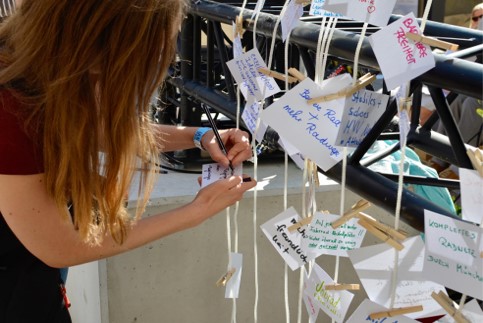
What is MOSAIQ about? MOSAIQ wants to make the streets in the city∙part more beautiful. People should feel comfortable there. There should be more space. For meetings and plants, for example. You can help decide what is tried out in the Stadt∙teil. The ideas come from you. Some ideas will be tried out on the streets for a certain period of time. The aim of MOSAIQ is to make urban districts good places to live. At the same time, the climate in the city should improve. And people should be able to move around the city easily.
What is happening in the district?
In the year 2025: The people in the district can participate. They can express their ideas. There are discussions, surveys and meetings. Researchers are also starting their work.
In the year 2026: Some ideas are tried out. They are moved around the streets for a certain period of time.
In the year 2027: The results are evaluated. Consideration is given to how things can continue∙.